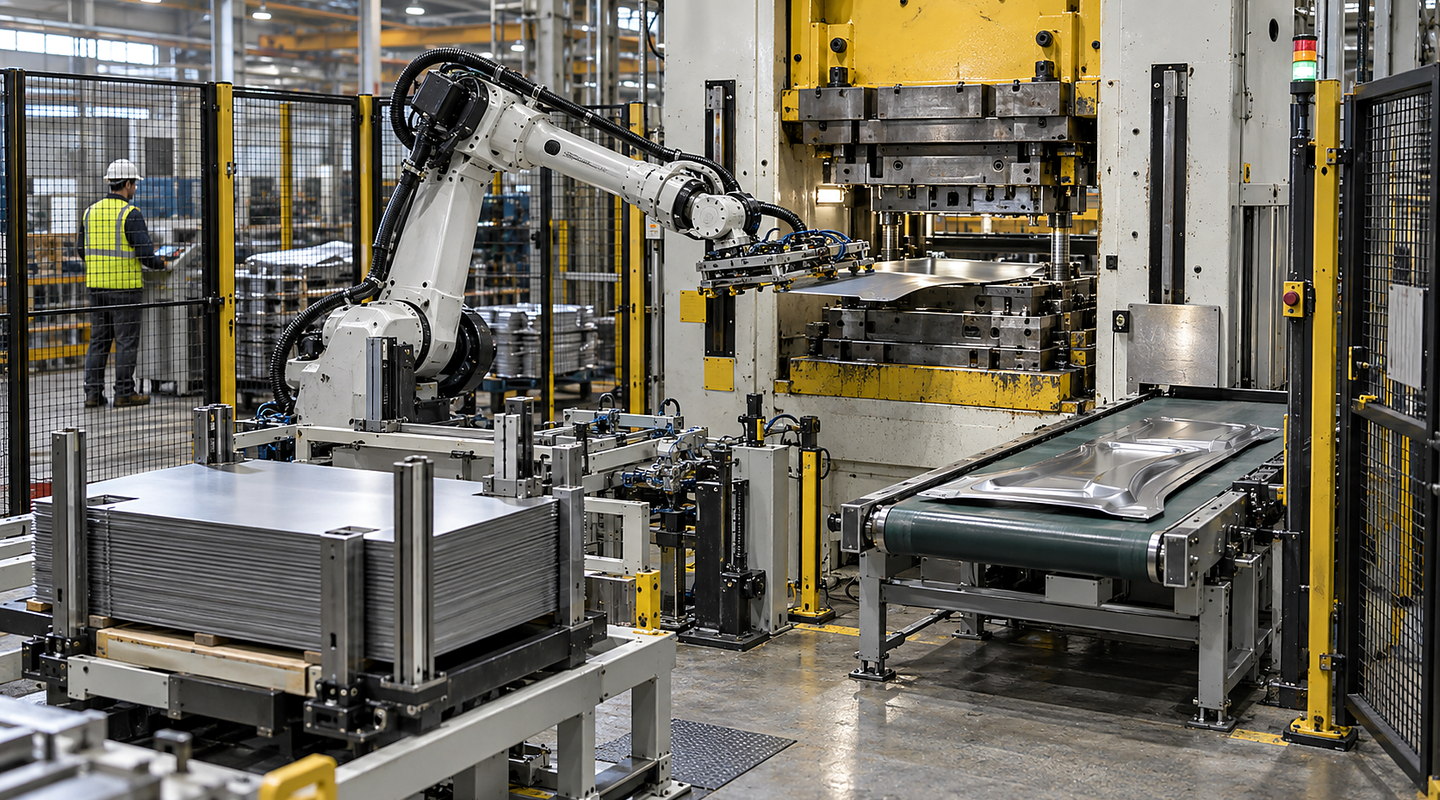
Robotic Bearing Assembly Selection Guide
Select bearing assembly automation using exact component and fit requirements, permitted loading surfaces, tooling, process evidence and abnormal-result trials.
Select an assembly route from the exact bearing and mating-part requirements, approved mounting method, part variation and complete production sequence. Assess permitted loading surfaces, alignment, support and tooling before comparing handling automation, process monitoring and changeover.
Prepare the dimension and variant matrix and representative run-off. Nominal bore size or robot repeatability alone does not establish compatibility with a particular bearing assembly.
Compare options in the conditions where they must work — Robotic Bearing Assembly
Plan robotic bearing assembly around your parts, process, cycle time, tooling, recovery and acceptance criteria. Discuss the highest-risk feasibility questions with Oxford Industrial Automation. A useful shortlist should show how every option copes with part, product and process variation for robotic bearing insertion & assembly and operator access, recovery and changeover.
Discuss your application
Ask every supplier the same questions
| Decision | What to ask | What to check |
|---|---|---|
| Component and method definition | Which exact bearing and mating-part variants, fits and mounting instructions apply? | Drawings/revisions, permitted loading surfaces and an explicit variant matrix rather than a nominal bore-size statement. |
| Incoming condition and presentation | How are components oriented, lubricated where specified, protected and identified before insertion? | Actual packaging and samples, drawing-limit variation and agreed wrong-part, empty-pick or damage checks. |
| Alignment, location and support | What locates the bearing and mating part, and which surfaces support the insertion load? | Fixture, part and transfer tolerances assessed together against the approved method. |
| Process evidence and finished result | Which force, position, time or other observations support acceptance, and what separate checks are required? | Agreed criteria and part-linked records with explicit evidence limits; a completed movement alone is insufficient. |
| Cycle, changeover and recovery | What complete sequence and variant changes must the cell perform? | Feeding, checking, insertion, unloading and records included, with incomplete/abnormal cycles and controlled restart. |
| Support and later changes | Who owns tooling/settings revisions, maintenance, abnormal-part decisions and requalification after a change? | Named responsibilities, retained faults and authorised rework/release rules with appropriate renewed trials. |
Include simpler approaches to robotic bearing insertion and assembly in your shortlist
| Approach | Often suitable when | Watch for |
|---|---|---|
| Robotic Bearing Assembly | Robotic presentation and transfer can be assessed alongside a defined insertion method for the intended part range. | Prove location, support and the mounting process separately from robot motion; include complete-cycle and abnormal-result evidence. |
| Purpose-Built Mechanical Automation for a Stable, Very High-Volume Task | A stable bearing and mating-part arrangement can be compared with dedicated feeding, fixtures and process tooling. | Confirm the approved loading surfaces, variation and recovery cases; the automation category alone establishes no rate or fit quality. |
| Operator-Assisted Fixtures where Flexibility or Business Case Does Not Support a Robot Cell | Operator loading and defined fixtures may suit the part mix, order pattern and required flexibility. | Assess location, support, operator tasks and insertion evidence using the same approved method and finished-assembly criteria. |
Pause before choosing when…
- Only perfect or hand-selected examples of repeatable production using robotic bearing insertion and assembly are available.
- No one has defined how run-off criteria and production evidence will be evaluated.
- The normal range for part, product and process variation for robotic bearing insertion & assembly is described only as “usually fine” but has not been bounded.
- Your operator, cleaning, maintenance or recovery access has not been considered.
- Quoted performance depends on another machine or data source that is not included.