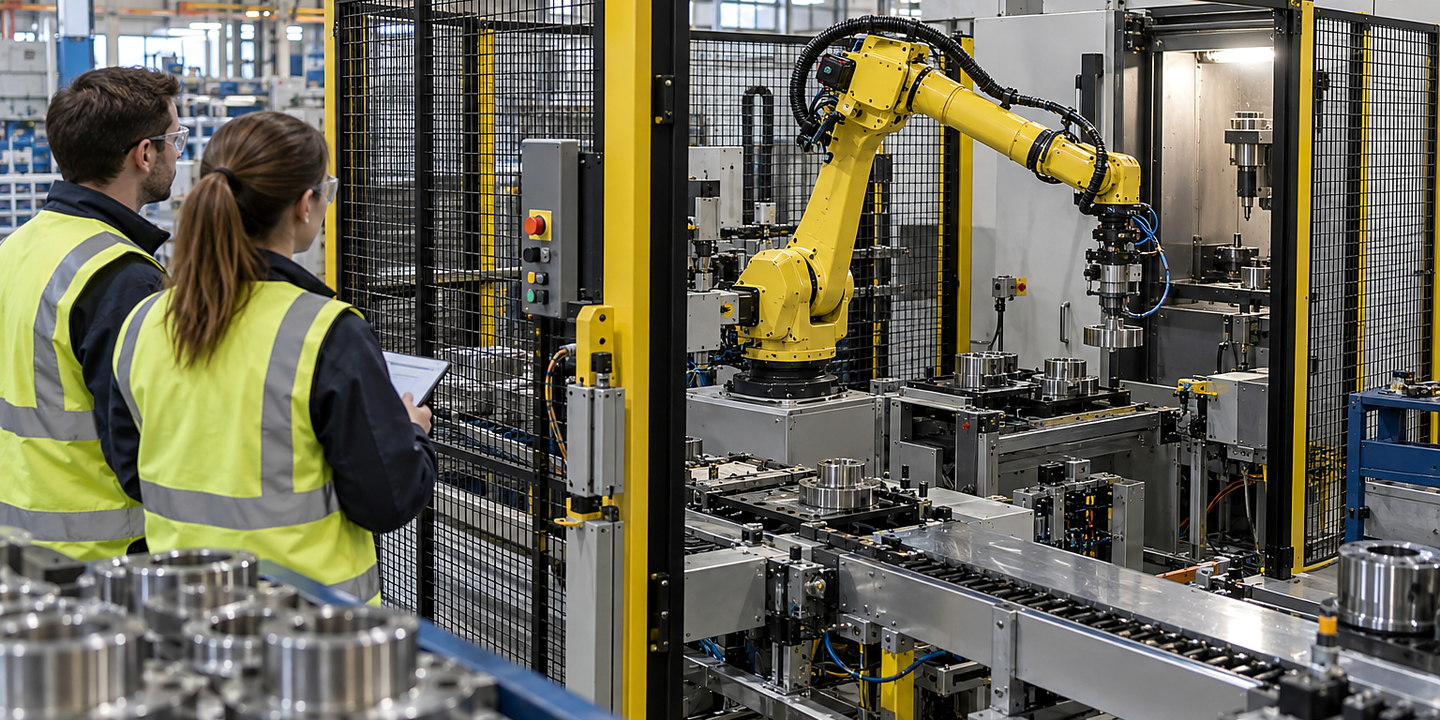
Plan support for a robotic bearing assembly cell with tooling and fixture records, controlled settings, abnormal-insertion evidence and agreed recovery.
In brief
Support planning for a robotic bearing assembly cell starts with its tooling, fixtures, settings, monitored insertion records and approved recovery method. Keep part and tool revisions, maintenance responsibilities and observed faults together so changes can be assessed against the approved assembly process.
Use the cell and assembly brief and abnormal-result checks. If an enquiry concerns repair or maintenance of a bearing already in service, identify that separately in the enquiry so the requested service scope can be confirmed.
On the production floor
Plan straightforward operation, maintenance and recovery — Robotic Bearing Assembly
Plan robotic bearing assembly around your parts, process, cycle time, tooling, recovery and acceptance criteria. Discuss the highest-risk feasibility questions with Oxford Industrial Automation. Plan the information, access and response needed to keep your operation running safely and consistently.
Keep the approved mounting method, component/tool revisions, fixture drawings, settings and software backups with the operating instructions. Train part identification, abnormal-result handling and the documented recovery route.
Planned care
Agree cell inspection, cleaning, wear-part and calibration tasks where applicable with the responsible equipment teams. Include tooling contact surfaces, fixture location/support and sensing that affect the approved insertion process.
Fault recovery
Retain the affected assembly identity, active settings and force/position or other process evidence when a result is incomplete or abnormal. Define escalation, controlled disposition and required checks before release; uncertain units must remain identifiable.
Future changes
Review new bearing or mating-part variants, fits, lubrication requirements, tooling, settings and software before treating earlier evidence as applicable. Record the approved change and the trial, inspection or functional checks it requires.
Support information
Keep the right information about robotic bearing assembly available to your team
Agreed robotic bearing insertion and assembly scope, exclusions and decisions
Current drawings, line-connection schedule and bill of materials
Software and parameter backups with revision control
Risk, test and inspection records for run-off criteria and production evidence
Operator and maintenance instructions for repeatable production using robotic bearing insertion and assembly
Recommended spares based on consequence and lead time
First-line response
For Robotic Bearing Assembly, record the equipment or process condition before making a change
Observe
Record the cell state, component and tooling revisions, active settings, recent changes and the affected part. Preserve the original abnormal trace or result and describe whether the issue arose during handling, alignment, insertion or release.
Make safe
Use the approved isolation or intervention method for repeatable production using robotic bearing insertion and assembly; never defeat a safeguard or force an output to shorten diagnosis.
Recover deliberately
Follow the approved recovery sequence and authorised disposition for the affected assembly. Retain the fault, action and review record, and verify the required checks before confirming the next accepted unit.
Change control
Revisit evidence when the duty changes
A new variant or higher rate can alter part, product and process variation for robotic bearing insertion & assembly, arrival pattern and presentation, required cycle and production pattern, tooling, sensing and process interfaces, operator access, recovery and changeover, and run-off criteria and production evidence. Record the change, assess consequences and repeat the relevant trial or validation rather than assuming the previous result transfers.